Real Estate and Commutes: Redmond, WA vs Bellevue in 2026
King County gives buyers more than a few genuinely different markets to choose from, and weighing the pros and cons of living in Redmond, WA against Bellevue usually comes down to two things: what you're willing to pay for a home and how much of your day you want to spend in the car. Both cities sit close to the major tech campuses, both have serious park systems, and both have the kind of retail infrastructure that means you're not driving to another city for groceries.
What they're not is interchangeable. Home prices, property tax structures, and transit access all have real differences - and if you're buying in 2026, those details matter more than the broad strokes.
Housing Market and Home Prices
Inventory is the engine that drives pricing on the Eastside, and right now that engine is running tight. Redmond is sitting at about 164 available homes, which works out to roughly a three-month supply. Homes are moving in a median of 24 days, which doesn't leave much time for second-guessing.
Bellevue's market is similarly constrained, though the price variation by neighborhood is wide enough that two buyers both saying "I'm looking in Bellevue" can be talking about completely different financial situations. A downtown condo and a detached home with acreage aren't really competing products, even when they're in the same city.
Average Home Prices
Redmond's median home sale price as of mid-2026 is around $1,262,500 - down a modest 2.7% from the prior year, though Zillow puts the average home value somewhat higher at roughly $1.36 million. That gap between median sale price and average value isn't unusual; it reflects how much a handful of high-end transactions can pull the average upward.
Bellevue runs a bit higher. Recent data puts the median sold price at $1,299,000, with trailing six-month averages reaching $1.39 million. Neither city is a bargain, and you should plan your budget accordingly.
Types of Homes Available
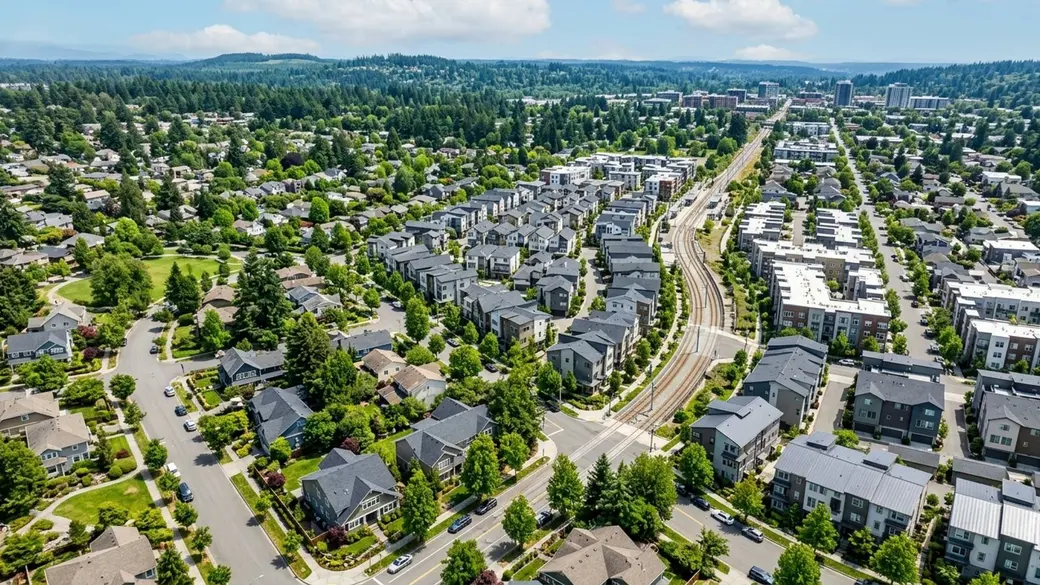
You'll find the full range in both cities - downtown condos, townhomes, and traditional detached single-family homes - though the mix shifts depending on where exactly you're looking. Downtown Redmond has seen a real concentration of condos and townhomes develop around the new light rail stations, which has changed the character of that core area noticeably.
Bellevue has its own high-rise and mid-rise condo options in the downtown core, with the established single-family neighborhoods sitting farther out. One pricing note for Redmond: sellers are generally holding firm, with average sale-to-list ratios at 97.9%.
Property Taxes and Daily Costs
The purchase price is the number everyone focuses on, but property taxes are what you pay every year for as long as you own the home - and in King County, they're not trivial. State and county levies apply to both cities, but local initiatives and city-specific rates mean your final bill depends on exactly where you buy.
Before you make an offer, get those tax obligations into your debt-to-income calculation. The 2025 and 2026 revaluations have updated what homeowners are paying in both Redmond and Bellevue, and the numbers shift year to year.
Redmond Property Taxes
Redmond's median effective property tax rate is 0.79%. That's below the Washington state median of 0.92% and below the national median of 1.02%.
Your actual bill, though, depends on your specific ZIP code. School district levies and local improvement districts vary enough that two homes with identical assessed values can carry different tax totals. Don't assume the median rate tells the whole story for the specific property you're considering.
Bellevue Property Taxes
Bellevue structures its taxes differently. The most common property tax rate in 2025 was set at $7.33 per $1,000 of assessed value - so on a home assessed at $1,000,000, you're looking at roughly $7,326 in total property taxes. Of that, the City of Bellevue itself collects $0.99 per $1,000, which is about 13% of the bill. The remaining 87% flows to King County, local school districts, and other taxing jurisdictions.
Commutes and Public Transit
The physical distance between Redmond and Bellevue is 7 to 8 miles. That sounds like nothing, and on a Sunday morning it is. On a Tuesday at 8 a.m., it's a different conversation.
Transit infrastructure on the Eastside has genuinely improved, and both cities benefit from that. But how those improvements affect your daily routine depends on where you're actually going.
Driving Times and Traffic
Redmond to Bellevue via SR-520 runs 15 to 25 minutes depending on traffic. For most Eastside commuters, that's workable. The trickier trip is Redmond to downtown Seattle - plan on 30 to 50 minutes westbound on SR-520 during peak hours.
Light Rail and Transit Options
The Redmond Technology/Microsoft Overlake light rail station is the transit development that changed the math for a lot of buyers. From that station, you're looking at 35 to 45 minutes into downtown Seattle - and you're not sitting in SR-520 traffic to get there.
That's a meaningful alternative, particularly if your office is in Seattle rather than on the Eastside.
Parks, Shopping, and Lifestyle
Day-to-day quality of life in these cities isn't just about square footage and commute times. Both Redmond and Bellevue have real recreational infrastructure and functioning commercial districts - not the kind you drive past without stopping.
Redmond, specifically, has integrated park access into its urban planning in a way that's noticeable on the ground.
Outdoor Recreation
Marymoor Park is the centerpiece - a large county facility along the Sammamish River with sports fields, walking trails, and space for major community events. It functions as a regional draw.
The Sammamish River Trail connects through the area, offering miles of paved paths for cyclists and pedestrians. You can get significant outdoor time without leaving the city.
Dining and Retail Centers
Downtown Redmond has been growing steadily, with its development tied closely to the light rail expansion. Dining and retail are concentrated within walking distance of the higher-density housing near those stations.
Redmond Town Center sits just outside the downtown core - an open-air complex with shopping, dining, and entertainment that serves residents across the broader Eastside.
Frequently Asked Questions
Is it more expensive to buy a house in Redmond, WA, or Bellevue?
Bellevue runs slightly higher. The median sold price there is $1,299,000, with some trailing averages near $1.39 million. Redmond's median sale price sits at $1,262,500, so the gap exists but it's not dramatic.
Do homes in Redmond and Bellevue belong to the same public school district?
Not necessarily - it depends on the specific address. School district boundaries vary by ZIP code and neighborhood, so check the boundary map for any home you're seriously considering before assuming anything.
Are property taxes significantly different between Redmond and Bellevue?
They're in a similar range but structured differently. Redmond carries a median effective rate of 0.79%, while Bellevue's most common 2025 rate was $7.33 per $1,000 of assessed value. Either way, your actual bill comes down to local levies and your home's assessed value.
How will the upcoming light rail expansion affect property values in Redmond vs Bellevue?
Specific projections vary, so I won't invent a number. What's concrete is the transit benefit: the Redmond Technology/Microsoft Overlake station now puts downtown Seattle 35 to 45 minutes away without touching SR-520.
If I work at Microsoft, is it better to buy in Redmond or commute from Bellevue?
Redmond gives you the shortest commute and direct access to the Redmond Technology light rail station. Bellevue is still manageable - 15 to 25 minutes by car across 7 to 8 miles via SR-520. Which one makes more sense depends on the rest of your priorities.
Will I face more bidding wars buying a single-family home in Redmond or Bellevue right now?
Both markets are competitive. In Redmond, homes are sitting a median of 24 days before selling, and roughly 13% of properties close above list price. Come prepared either way.
Categories
Recent Posts